

Fibreglass vs Concrete Pools: Which Is Right for Your Auckland Section?
If you are planning a new pool, the fibreglass vs concrete pool decision is usually the first big question you will face, and it is not always a simple one. Both options can deliver a beautiful, long lasting backyard pool, but they suit different sites, budgets and priorities. As fibreglass pool builders in Auckland who also specialise in custom concrete construction, we get asked this question almost every week, so we have put together a straightforward comparison to help you figure out which pool type is the right fit for your section.
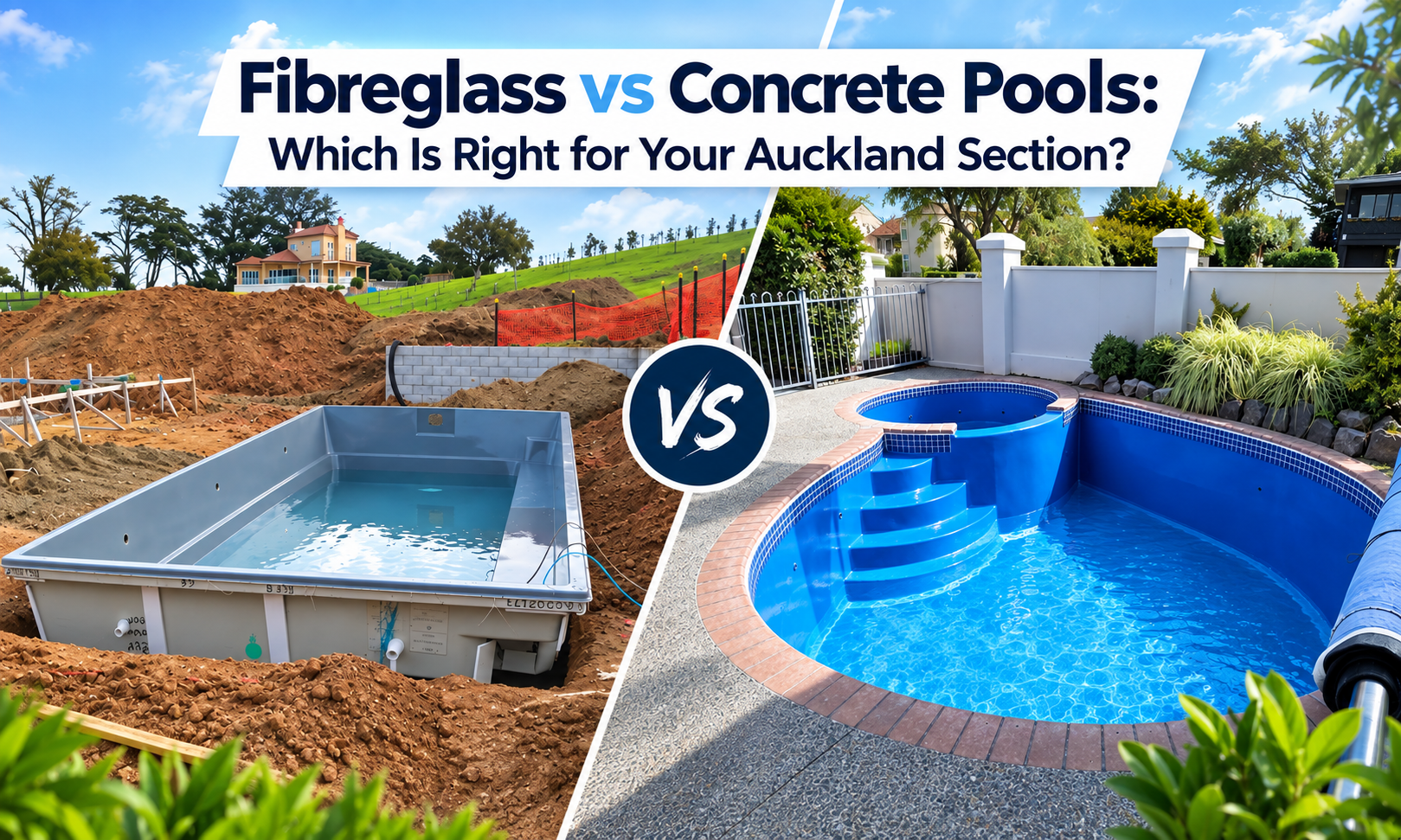
What Is a Fibreglass Pool?
A fibreglass pool is a pre-formed shell, manufactured off-site in a factory and then delivered to your property in one piece. Once your site is excavated and prepared, the shell is lowered into the ground, levelled, plumbed and backfilled. Because the shape and structure already exist before the pool arrives, the on-site construction time is usually much shorter than a concrete build.
Fibreglass pools come with a smooth, non-porous gel-coat surface that resists algae growth and is comfortable underfoot. They generally come in a set range of shapes and sizes, so if you want a very specific or unusual design, a fibreglass shell may limit your options compared to a custom concrete build. You can read more about the shapes and finishes we offer on our fibreglass pool page.
What Is a Concrete Pool?
A concrete pool is built on-site from the ground up, which means the size, shape and depth can be fully customised to your section, your budget and your vision. At Diamond Pools, our concrete pools are built using steel reinforced, poured concrete construction, which allows us to build strong, insulated pool structures that hold up over decades, even on sites with tricky ground conditions.
Because concrete pools are formed on-site, there is far more flexibility for features like tanning ledges, built-in spas, swim-outs, custom steps and unusual shapes that follow the natural contours of your yard. This is one of the main reasons concrete pool builders in Auckland tend to be the first call for architecturally designed homes or sites with unusual layouts. You can see examples of what is possible on our concrete pool page.
Cost Comparison: Fibreglass vs Concrete Pools in NZ
Cost is usually the deciding factor for most homeowners, so here is how the two typically compare.
Fibreglass pools are generally the more affordable option upfront, mainly because the manufacturing happens off-site and installation is faster, which reduces labour costs. For a straightforward, flat, easily accessible site, a fibreglass pool can be a cost effective way to get swimming sooner.
Concrete pools usually carry a higher upfront cost because everything is custom built and labour intensive, from excavation and steel reinforcement through to the concrete pour and interior finish. That said, a well built concrete pool is often viewed as a longer term investment, since the structure can last for decades and the interior finish can be renewed or upgraded down the track without needing to rebuild the pool shell.
If your site has sloped ground, tight access or challenging soil conditions, the cost gap can narrow, since these factors add complexity and cost to a fibreglass installation as well.
Installation Time
This is one area where fibreglass pools have a clear advantage. Because the shell arrives ready-made, installation can often be completed in a matter of weeks from excavation to first swim, weather and consent timelines permitting.
Concrete pools take longer to build because every stage happens on-site, from ground preparation and steel reinforcement through to the concrete pour, curing time and interior finishing. Depending on the size and complexity of the project, a concrete pool build can take several months. For many homeowners, this trade-off is worth it for the level of customisation and long-term durability concrete offers.
Customisation and Design Flexibility
If you want a completely bespoke pool, a swim-out, an integrated spa, a specific depth profile or a shape that fits an irregular section, concrete is generally the better choice. There is no size or shape limitation with a poured concrete build, since it is constructed specifically for your site.
Fibreglass pools come in a fixed range of pre-designed shapes and sizes. This is not necessarily a downside if one of the available designs suits your space, but it does mean less flexibility if your section is unusual or if you have a very specific vision in mind.
Durability and Maintenance
Both pool types are built to last, but they behave differently over time.
Fibreglass shells have a smooth, gel-coat surface that resists algae and generally requires less chemical balancing than a concrete pool, which can make ongoing maintenance simpler.
Concrete pools rely on their interior finish, whether that is quartz plaster, full tiling or another surface, and this finish can be refreshed or replaced over the years without touching the underlying structure. If your existing concrete pool is showing signs of wear, our pool refurbishment service can restore it to a like-new finish.
Which Pool Suits Difficult or Sloped Auckland Sections?
Auckland has no shortage of sloped sections, tight side access and tricky terrain, and this is often where the fibreglass vs concrete decision becomes clearer. A large, heavy fibreglass shell can be difficult or impossible to manoeuvre onto a steep or narrow site, whereas a poured concrete pool is built in place, piece by piece, which makes it far better suited to challenging ground.
If your section falls into this category, it is worth looking at our pages on building a pool on a sloped yard or a pool on a hillside, since these are exactly the kind of sites our concrete pool builders in Auckland specialise in.
Fibreglass vs Concrete: Quick Comparison
Upfront cost: Fibreglass is usually lower, concrete is usually higher
Installation time: Fibreglass is faster, concrete takes longer
Customisation: Fibreglass is limited to standard shapes, concrete is fully custom
Difficult sites: Fibreglass can struggle with access and slope, concrete adapts to almost any site
Long-term finish: Fibreglass surface is fixed, concrete finish can be renewed over time
Best for: Fibreglass suits flat, accessible sections wanting a quicker build. Concrete suits custom designs, difficult sites and long-term durability
Which Pool Is Right for You?
There is no universally right answer here, since the best choice depends on your section, your budget, your timeline and how much customisation you want. A flat, easily accessible backyard with a standard shape in mind might be perfectly suited to a fibreglass pool. A sloped section, an unusual layout or a desire for a fully bespoke design will usually point toward a concrete build.
The good news is that you do not need to figure this out on your own. Our team can assess your site and talk you through the realistic options and costs for your specific property. If you would like a professional opinion, get in touch with our team for a free, no-obligation consultation.
Frequently Asked Questions
Is fibreglass or concrete cheaper for a pool in NZ?
Fibreglass pools are generally cheaper upfront due to faster installation and lower labour costs. Concrete pools cost more initially but offer greater customisation and long-term value, especially since the interior finish can be renewed without rebuilding the structure.
Which pool type lasts longer, fibreglass or concrete?
Both can last for decades when properly built and maintained. Fibreglass shells are durable and low maintenance, while a well built concrete pool structure can last well beyond 50 years, with the interior finish able to be refreshed periodically.
Can I build a fibreglass pool on a sloped section in Auckland?
It depends on the severity of the slope and access to the site. Large fibreglass shells can be difficult to manoeuvre onto steep or tightly accessed sections, which is why concrete is often the more practical choice for these sites.
How long does it take to install each type of pool?
Fibreglass pools can often be installed within a few weeks, since the shell arrives pre-made. Concrete pools typically take a few months from excavation to completion, due to the on-site construction, curing time and finishing process.
Can I add a spa or special features to a fibreglass pool?
Some features can be incorporated, but fibreglass pools are generally more limited in customisation than concrete since the shell shape is fixed. If you want an integrated spa, custom steps or unusual features, a concrete pool offers far more flexibility.
Do concrete pools need more maintenance than fibreglass pools?
Concrete pool surfaces can be slightly more porous than a fibreglass gel-coat, which may mean marginally more attention to water chemistry. However, modern finishes such as quartz plaster are designed to minimise this difference significantly.
Which pool type is better for resale value?
A well built custom concrete pool is often viewed as a premium addition to a property, particularly for architecturally designed homes. That said, either pool type can add value when it is well maintained and suits the style of the home.
Can Diamond Pools build both fibreglass and concrete pools?
Yes. We build both fibreglass pools and custom concrete pools, including builds on challenging sloped and hillside sections across Auckland. Get in touch for a free consultation and we will help you decide which option suits your property.
